
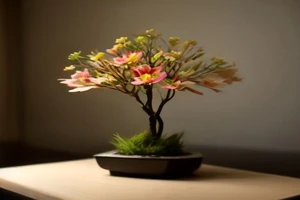
Ikebana, the Japanese art of flower arranging, does not try to fill a vase. A few stems, a branch, a lot of empty space: each element is chosen for what it expresses. It is another way of letting flowers speak, very different from our round, generous bouquets.
Heaven, human and earth
An ikebana arrangement traditionally rests on three lines. The tallest, shin, represents heaven. The second, soe, stands for the human being. The lowest, hikae, evokes the earth. Together they form an asymmetrical triangle that places the human between sky and ground.
The message is therefore not carried only by the species chosen: it also lies in the direction of the stems, the curves and the empty spaces. The space left free is part of the sentence. A single flower, well placed, can be enough.
Hanakotoba, the Japanese language of flowers
Japan has its own language of flowers, hanakotoba. Composing an ikebana also means choosing what you want to say, and the meanings do not always match those of Europe.
- Cherry blossom (sakura) speaks of the beauty of what passes, the sweetness of a moment known to be fleeting.
- The yellow chrysanthemum, emblem of the imperial family, expresses nobility; far from French cemeteries, in Japan it is a flower of honor.
- The red camellia (tsubaki) speaks of love; our camellia page also tells of its place in Western tradition.
- The white lily evokes purity, as the lily does in the West.
- The balloon flower (kikyō) speaks of an unchanging love.
- The iris (ayame) is associated with courage and protection; it is honored on Children’s Day, in early May.
- The hydrangea (ajisai), on the other hand, carries a hint of coldness and inconstancy, close to what the blue hydrangea means in Europe.
The seasons in the vase
Ikebana follows the rhythm of nature. You compose with what the season offers: plum branches at the end of winter, cherry blossom in spring, irises in early summer, russet foliage in autumn. Giving or displaying a seasonal flower says that you live in the present moment, an idea dear to Japanese culture.
This attention to the seasons echoes Western traditions too. Our articles on lucky plants for the New Year and the flowers of winter give a few examples.
Composing a message the Japanese way
To try this spirit at home, you need no special equipment. Choose a flower for what it means, add a branch or some foliage to give it a line, and leave space around it. Do not look for symmetry: nature has none. Simplicity brings out the message.
A simple arrangement, with one flower chosen for its meaning, often says more than a full vase.