
The carnation is the flower of faithful affection and commitment. Its meaning depends above all on its color: red, it speaks of a lively love or a cause defended; white, of purity and faithfulness; pink, of a mother’s love. A modest and sturdy flower, long worn in the buttonhole, it speaks less of passion than of constancy.
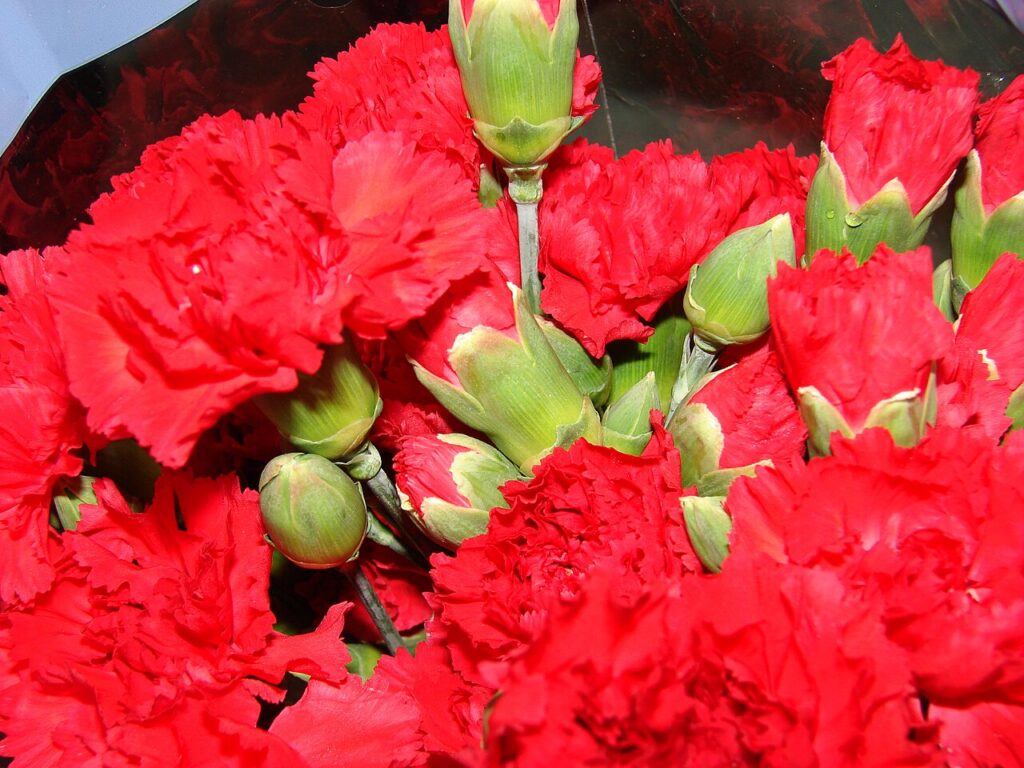
Credit: Forest & Kim Starr, CC BY 3.0, via Wikimedia Commons
What does the red carnation mean?
In the language of flowers, the red carnation carries two messages that echo each other. In matters of the heart, it expresses deep affection: bright red, it says “my heart aches for you”; light red, it expresses admiration and respect. It is a more reserved declaration than that of the red rose, but just as sincere.
On a collective level, at the beginning of the twentieth century the red carnation became the emblem of workers’ struggles. It was worn in the buttonhole on May 1 in France, Italy and Austria, before lily of the valley took its place in France. In Portugal, it remains the flower of the revolution of April 25, 1974: soldiers slipped red carnations into the barrels of their rifles, and the country has kept the name “Carnation Revolution”. Giving a red carnation is therefore also a way to salute someone who fights for what they believe is right.
The other carnation colors
- White carnation: pure love, faithfulness, the good luck you wish someone. In the United States, it has been the emblem of Mother’s Day since its founder, Anna Jarvis, chose it in tribute to her own mother.
- Pink carnation: a mother’s love, tender and unchanging. A Christian legend says that pink carnations grew where Mary’s tears fell at the foot of the cross, and Leonardo da Vinci painted a Madonna of the Carnation in which the child reaches for the flower.
- Mauve carnation: whimsy, a changeable, almost capricious mood.
- Purple carnation: a sullen temper, thwarted feelings.
- Striped carnation: refusal, or at least an answer left pending. It is given when you are not ready to say yes.
- Yellow carnation: disdain, disappointment, sometimes the wish to break up. Better avoided in a romantic bouquet.
- Green carnation: Saint Patrick’s Day in Ireland and, since Oscar Wilde wore one in his buttonhole, a nod to elegance and a rebellious wit.
Do carnations bring bad luck?
Many French families pass down the idea that you do not give carnations. The belief comes mainly from the theater: it is said that theater managers once had a bouquet of carnations handed to actors whose contracts would not be renewed, while the others received roses. Backstage, the carnation thus became the flower of dismissal, and the superstition spread to the rest of society.
Yet nothing in the language of flowers makes the carnation an ill-fated flower. Elsewhere in Europe and in the English-speaking world, it accompanies celebrations, weddings and peaceful revolutions. If the person you have in mind is sensitive to it, choose another flower; otherwise, the carnation remains a lovely message of faithfulness.
Who to give carnations to?
The carnation suits lasting relationships more than first stirrings of love. It is gladly given:
- to your mother or grandmother, in pink or white (more ideas in our Mother’s Day article);
- to a long-time partner, in red, to say that affection does not wear out;
- to someone embarking on a struggle, a competition or a new life, to salute their courage;
- in the buttonhole of a groom or a best man, where it lasts a long time without wilting.
For that is one of its qualities: once cut, the carnation often lasts more than two weeks in a vase. A flower that holds firm, for a message that says the same thing.
A flower with a scent of cloves
Its Latin name, Dianthus, means “flower of Zeus” or “divine flower”. Old carnations give off a peppery scent close to that of cloves, which the florist’s carnation’s name, caryophyllus, also refers to. Its jagged petals, as if cut with pinking shears, give it that look of crumpled lace you recognize from afar.
For a more nuanced bouquet of faithfulness, the carnation goes well with the peony, which adds the promise of lasting happiness, or with lavender, which adds tenderness.
Nobody gives green carnations on St. Patrick’s day….