
Fragile, dazzling, already faded by the next day: in the language of flowers, the poppy carries a message of consolation and fleeting love. It says “let us love while we can”, because its beauty does not last. It also evokes rest, the forgetting of sorrows and, since the Great War, the memory of those who fell.
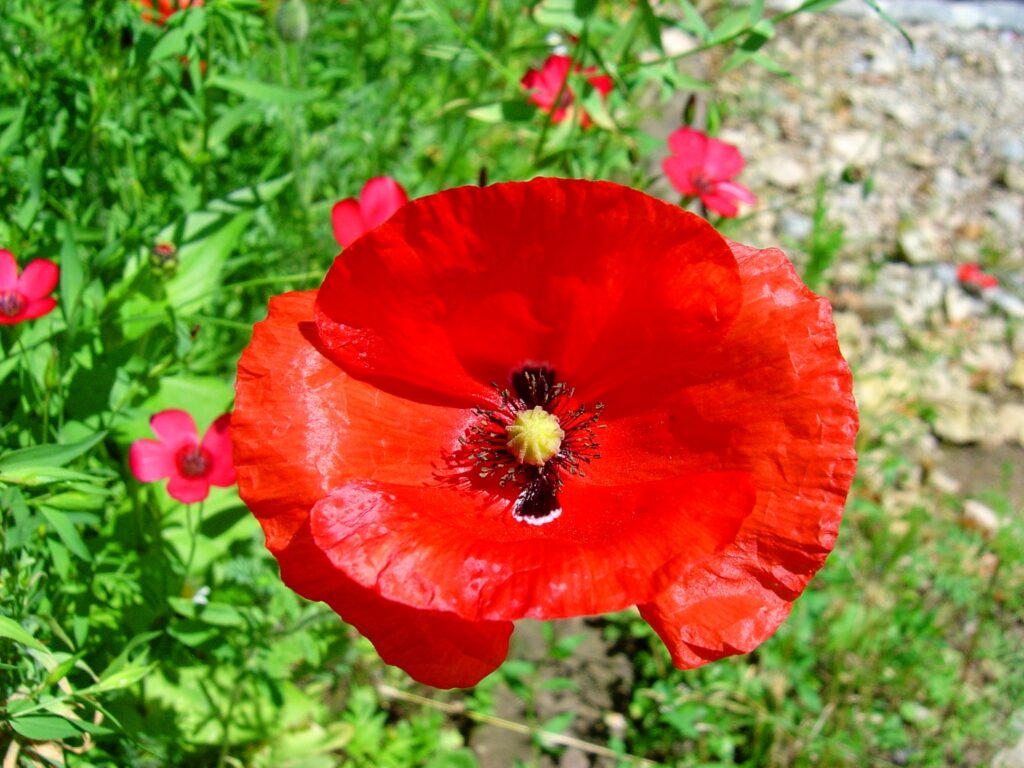
Credit: Thomas Bresson, CC BY 2.5, via Wikimedia Commons
The flower of wheat fields and roadsides
The poppy does not like vases. Once picked, it droops within hours; left in the fields, it makes its petals of crumpled silk dance at the slightest breath. It is a free, wild flower that returns every year without being sown: its seed heads release thousands of seeds that the wind scatters. The Impressionist painters loved it for that, Monet first among them, whose Poppies turn a hillside at Argenteuil red.
Its French name, coquelicot, is said to come from the rooster’s call, coquerico, because its color recalls the bird’s crest.
Sleep, forgetting and consolation
In antiquity, the poppy was the flower of sleep. The Egyptians scattered its petals in tombs to offer the dead a gentle rest. The Greeks told how Morpheus, god of dreams, seeing Demeter exhausted from searching for her daughter Persephone, made her breathe poppies so that she could finally sleep. Hypnos and Morpheus are often shown crowned with these flowers.
From this legend comes its oldest meaning: to give poppies is to bring comfort to someone who is suffering, whether from heartbreak or the loss of a loved one. The flower lulls the pain and invites peace.
The poppy, a symbol of love
In love, the poppy speaks of the urgency of living. Its beauty fades so fast that it must be enjoyed at once: it says “let us love now”, “let us not let the moment pass”. It is a flower of ardor and carefreeness, suited to summer loves, spontaneous impulses and slightly mad declarations.
Its bright red recalls passion, its black heart the share of mystery that every love keeps. And since it reseeds endlessly, it has also become a symbol of fertility and abundance: a love that bears fruit.
The flower of remembrance
During the First World War, poppies bloomed in masses on the churned-up ground of Flanders and the Somme. The poem In Flanders Fields, written in 1915 by the Canadian doctor John McCrae, made it the flower of fallen soldiers. Since then, in the United Kingdom, Canada, Australia and Belgium, people wear a poppy in their buttonhole in November to honor their memory.
In France, the cornflower plays this role, but the poppy keeps there too its meaning of remembrance and faithfulness to the departed.
Giving poppies
How do you give a flower that will not last in a vase? You can pick a few stems at the edge of a field and plunge them at once into very hot water, which helps them last a day or two. You can also give seeds, so that the message blooms again every summer, or poppy sweets and syrups, a specialty of the French town of Nemours, with a short note.
For a country bouquet, the poppy goes with daisies and cornflowers: the red, white and blue of June meadows. To speak of consolation in a longer-lasting bouquet, the white lily or the white rose will take over; for a passionate love that wants to last, the red rose.